July 26, 2026
I Crocheted a Hyperbolic Plane
pioneered by Dr. Daina Taimiņa 🧶
introduction
I first learned how to crochet during the pandemic, probably as a result of my increasing freedom to peruse the Internet for yet another crafty hobby. I am honestly not sure how my parents have let me get away with buying so many craft supplies.
I started off with a lot of amigurumi, then decided to bite the bullet and tackle larger projects. After a small (impractical) backpack and a (beautiful) daisy tote bag, I started buying clothing patterns. Currently I’ve only managed to finish one shrug and one cardigan. Please don’t ask me how much excess yarn or how many WIPs I have.
Then the realities of life hit, and crocheting became one of those hobbies that I tell everyone about in icebreaker conversations… but I only actually manage to do it once every few months. I’ve been meaning to get back into it this summer.
hyperbolic planes?!
my introduction to the topic
During a linear algebra (MAT223) lecture, my professor Dr. Sarah Mayes-Tang saw my crocheted mushroom keychain on my backpack and we had a lovely chat about crocheting and fibre arts. She mentioned the Crochet Coral Reef project to me, started by Christine Wertheim and Margaret Wertheim, and I was super interested. However, I never got around to crocheting my own model until I searched up hyperbolic planes yesterday, and found out through rabbit holes that Dr. Daina Taimiņa pioneered the method.
an attempted explanation
Essentially, a hyperbolic plane has constant negative curvature (as opposed to flat Euclidean planes, which have a curvature of 0). Thus, hyperbolic surfaces grow exponentially at a constant rate, which makes it difficult to simulate using paper (fragile) or fabric (awkward seams). This led Dr. Taimiņa to think of using crochet to model it in three dimensions in 1997.
With crochet, a regular ‘single crochet’ stitch links your previous stitch and the next stitch from the previous row together, which usually results in a flat Euclidean surface. For each stitch in the previous row, you create one corresponding stitch in the next row, so the exponential growth ratio is 1.
However, an ‘increase’ is where you do two ‘single crochet’ stitches into the same stitch from the previous row. If you add increases at regular intervals (let’s say at every N stitches), you’re increasing the surface exponentially by a constant ratio of (N+1)/N.
Increase stitches are essential to creating 3D crochet pieces, and I find it beautiful that something so complicated and difficult to wrap your mind around in mathematics is something that beginner crocheters can easily create.
additional resources
- TED Talks: “Crocheting hyperbolic planes” by Dr. Taimiņa (full transcript) & “The beautiful math of coral (and crochet)” by Margaret Wertheim
- Paper: “Crocheting the Hyperbolic Plane” by Dr. Taimiņa
- Book: Crocheting Adventures with Hyperbolic Planes by Dr. Taimiņa
- YouTube video (crochet tutorial): “Make Your Own Hyperbolic Surface!” by CodeParade
- YouTube video (hyperbolic geometry): “Non-Euclidean Geometry Explained - Hyperbolica Devlog #1” by CodeParade
- Written crochet tutorial: “The Ultimate Beginner’s Guide to Hyperbolic Crochet” by Start Crochet
- Wikipedia: Hyperbolic geometry
- Related article: “Hyperbolic Surfaces for Ukraine” by Dr. Tanya Khovanova
my crocheting process
I wanted to gain a better intuition for hyperbolic surfaces myself, so I decided to crochet one today. My friend and I conveniently already had plans to go to a cafe and crochet + yap for a few hours.
Overall, it took around 2 hours for a smaller product than I would’ve liked. I originally tried starting with 7 single crochets in a magic circle and adding an increase stitch every 4 stitches (N=4), but it wasn’t curling up fast enough for my liking. I frogged the whole thing and went with a start of 5 single crochets and N=2 instead.
Here it is!! I am very proud. :D
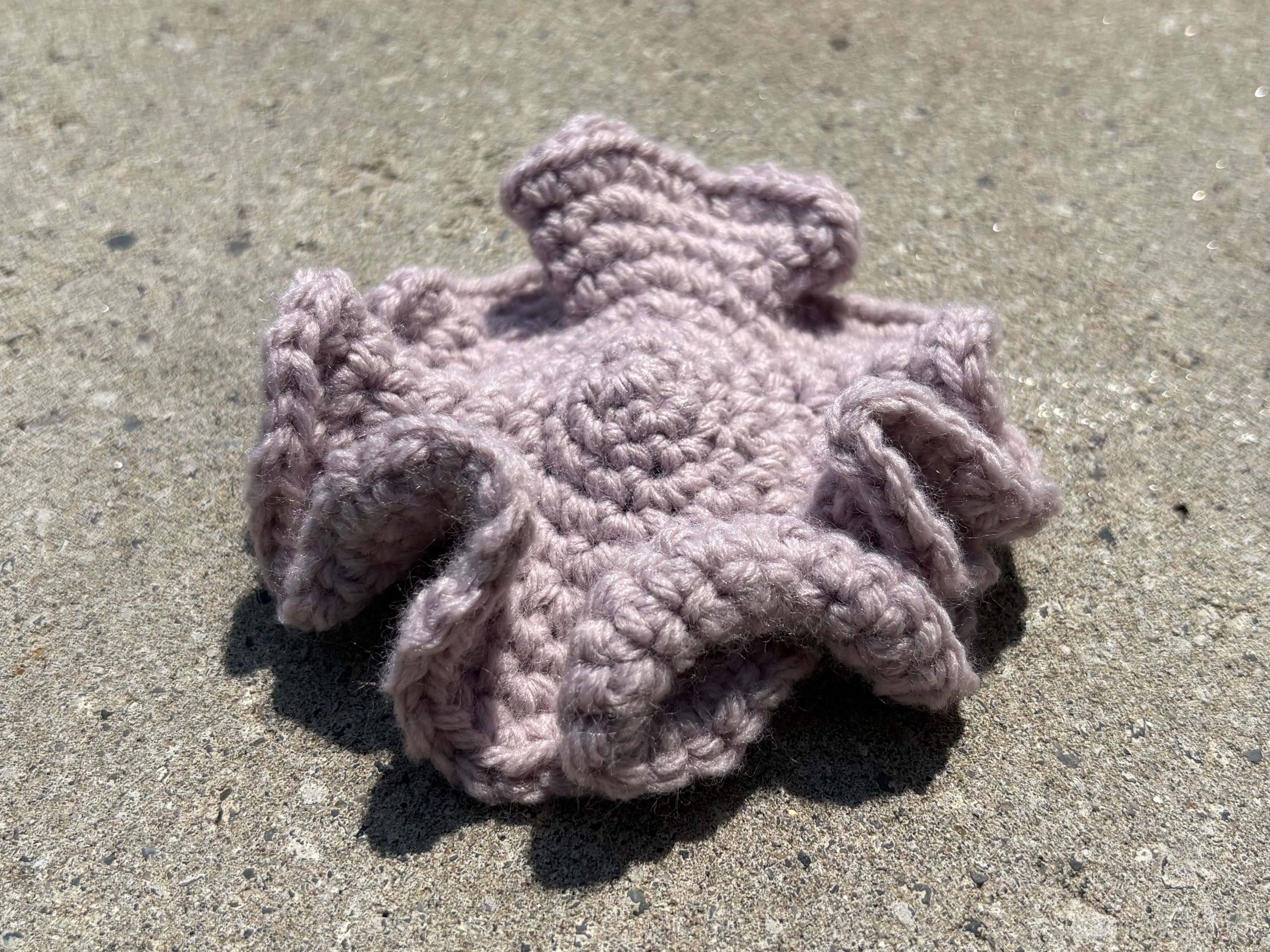
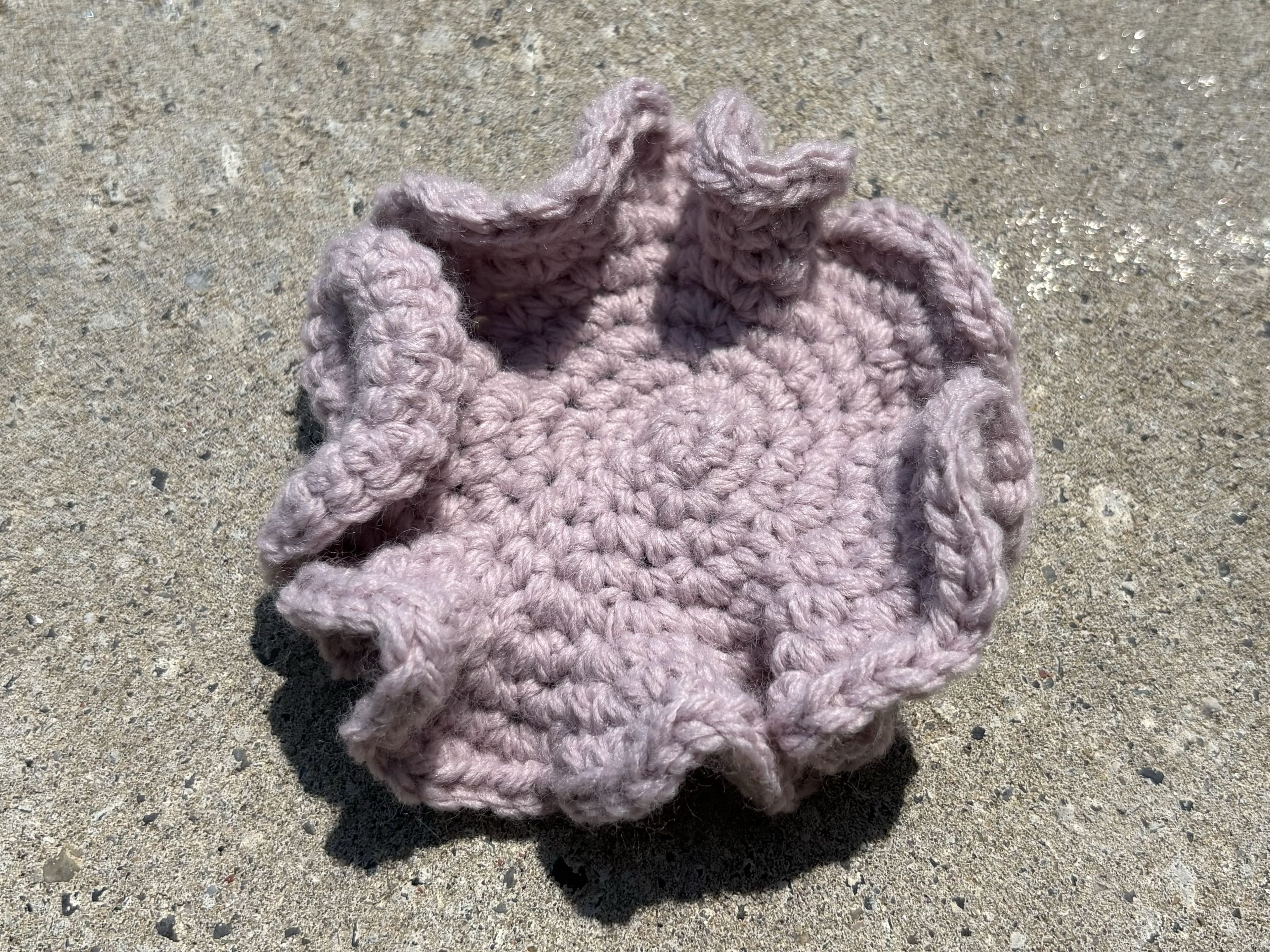
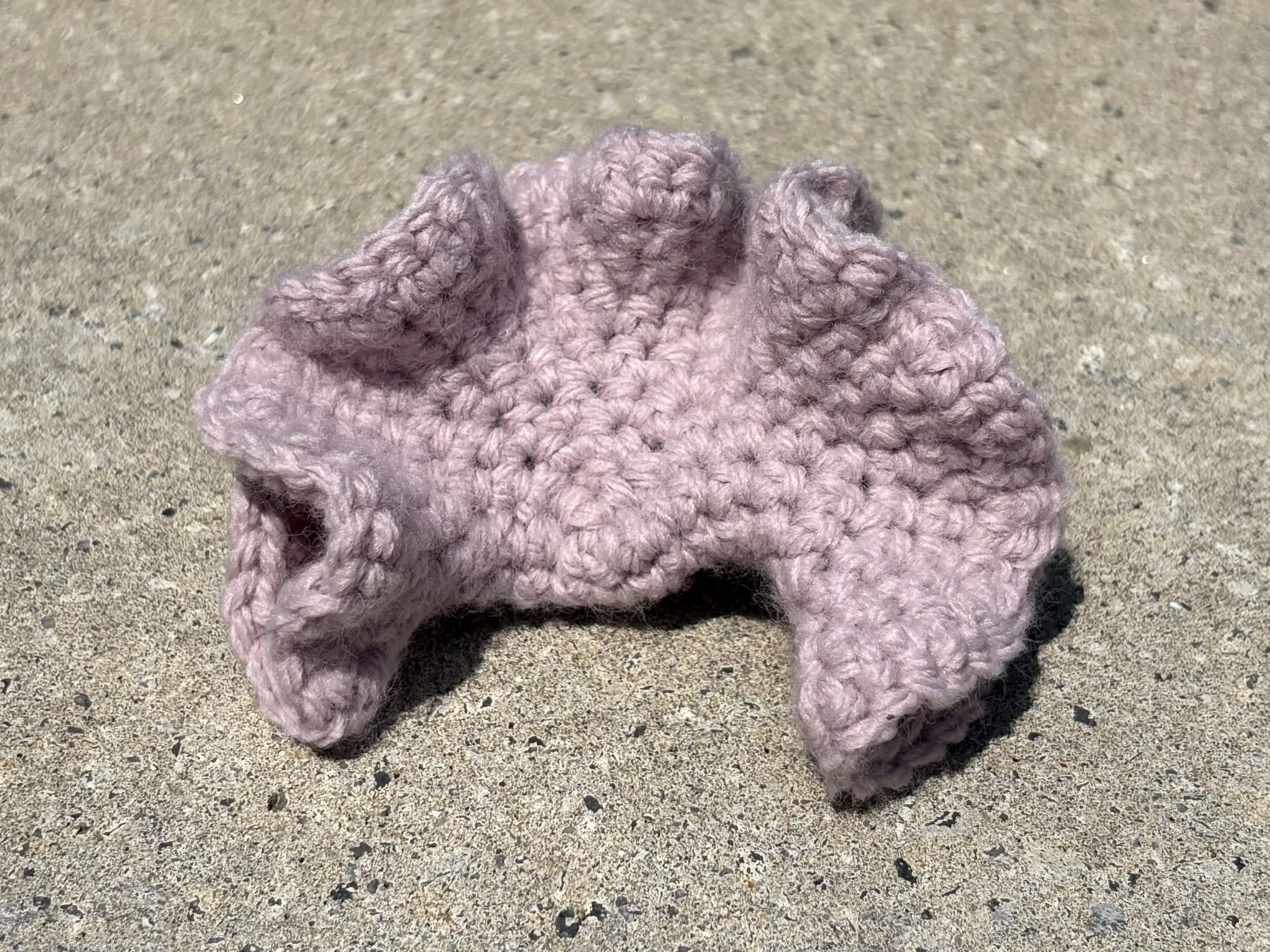
I think this is an amazing teaching tool, since it can be folded/bent/manipulated however. It is very fun to play with the ruffles and try to flatten them, only to create more ruffles nearby. It can also be folded along many different axes and I can intuitively follow along the stitches to see how ultraparallel lines diverge.
concluding thoughts
on crocheted hyperbolic planes
I would like to make more of these in the future — they’re fun room decor, maybe they’ll help me with math courses in the future, and honestly these are not bad gifts for my math nerd friends. Experimenting with the radius of curvature w(values of N) would be interesting. I also think doing more topological crochet projects would be fun, like a Möbius strip or a Klein bottle — I found Shiying Dong’s (@clay_mushi) incredible topological crochet on Instagram and definitely plan on trying some of her free patterns.
on feminism
Dr. Taimiņa mentioned in her TED Talk how difficult it was for her to get her hyperbolic crochet papers published in reputable math journals, as crocheting was seen as a simple woman’s craft. Despite this, almost 30 years later, her idea of hyperbolic crochet continues to be the only useful real-world model of hyperbolic surfaces.
Thanks to Dr. Taimiņa and many other women in academia, we’ve seen how intrinsically tied women’s crafts are to mathematics. Sewing, crocheting, knitting, cross-stitching, quilting, and more have all made me gain a better understanding of how independent threads of symbols and languages can interweave into something greater and abstract.
I do believe the academic world has improved today. However, as always, there is a lot more work to be done, and I hope that this blog post’s impact contributes (even if minutely) to the cause of feminism in mathematics. If not, then at least I have a fun hyperbolic plane to play with. :D
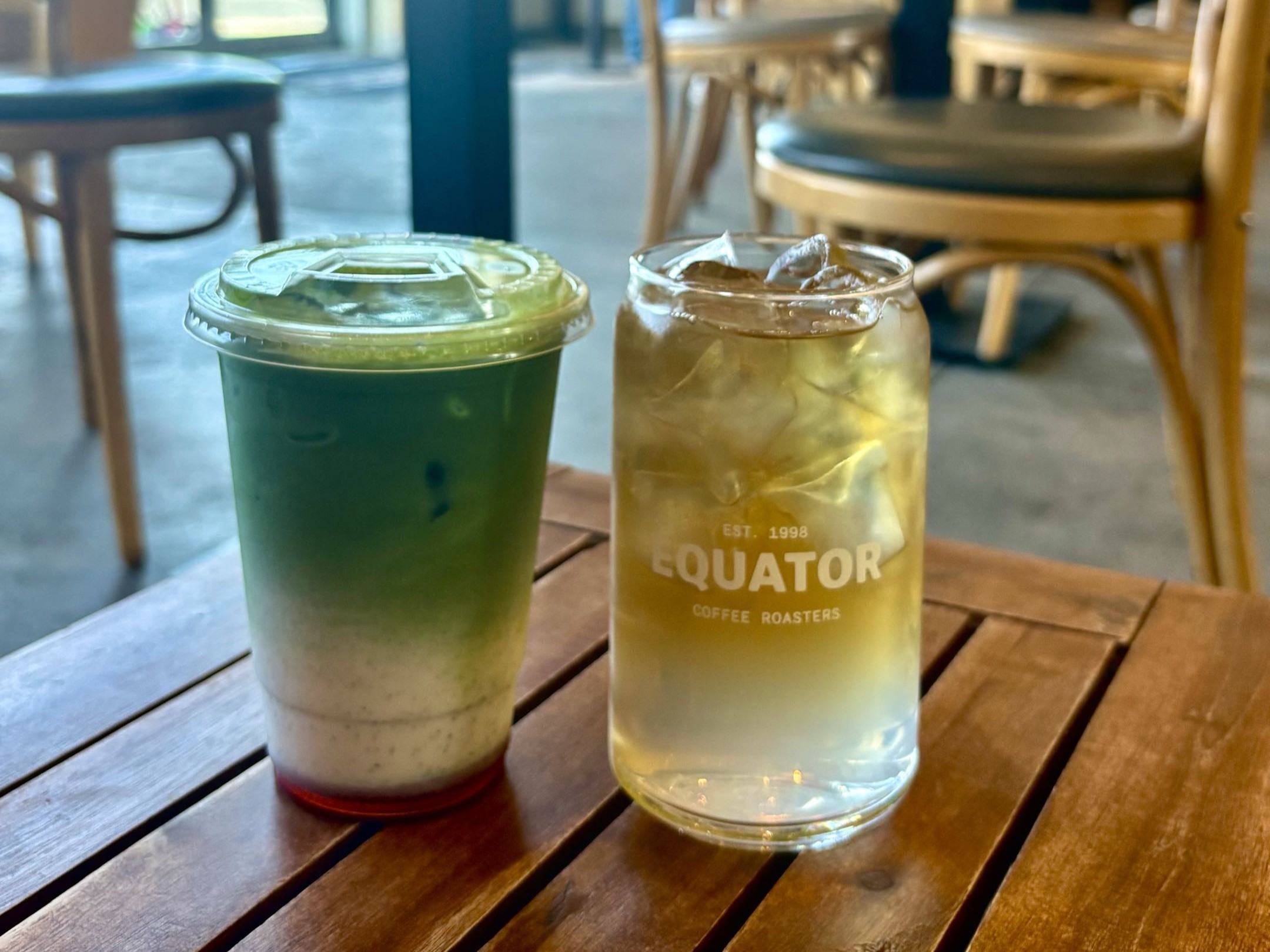
P.S. Equator Coffee (locally owned in Almonte, with locations in Ottawa) has amazing drinks. Below are my friend’s strawberry matcha and my peach blossom lemonade.